Flight: From Kitty Hawk to the Jet Age
For all of human history, the sky belonged to birds. People dreamed of flying for thousands of years — in myths, in drawings, in doomed attempts with feathers and wax — but nobody had ever built a machine that could carry a person through the air under its own power and land safely. Then, on a cold December morning in 1903, two bicycle makers from Ohio did it on a sand dune in North Carolina. The first flight lasted 12 seconds and covered 120 feet — less than the wingspan of a modern airliner. Within a single lifetime, aeroplanes were crossing oceans.
In short
On 17 December 1903, at Kitty Hawk, North Carolina, Orville Wright made the first controlled, powered, heavier-than-air flight: 12 seconds and 120 feet. The brothers made four flights that day, the longest 852 feet in 59 seconds. Within 25 years, Charles Lindbergh had flown solo across the Atlantic, and by 1958 jet airliners were carrying passengers across oceans in hours.
The bicycle makers who solved flying
Wilbur and Orville Wright ran a bicycle shop in Dayton, Ohio, and they brought a bicycle maker's way of thinking to flying. Others had built gliders and engines, but nobody had solved the real problem: control. An aeroplane that cannot be steered is useless, however powerful its engine. The Wrights' key invention was "wing warping" — twisting the wings to bank the aircraft, like a cyclist leaning into a turn — together with a movable rudder. They tested their ideas with kites and gliders, and with a small wind tunnel they built themselves, before they ever fitted an engine.
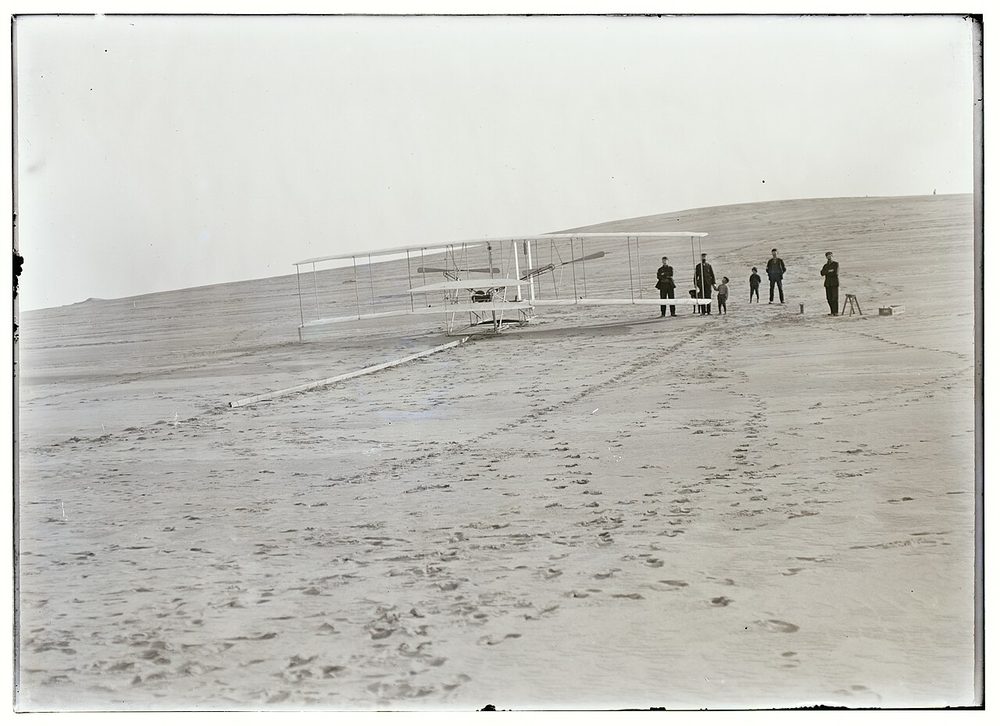
On 17 December 1903, with temperatures near freezing and winds gusting to 27 miles per hour, they were ready. At 10:35 in the morning, Orville took the pilot's place on the Flyer while Wilbur ran alongside, steadying the wing. The machine rolled down its launching rail, lifted into the air, and flew — unsteadily, rising and dipping — for 12 seconds and 120 feet before landing in the sand. They made three more flights that day. The last, with Wilbur piloting, covered 852 feet and stayed airborne for 59 seconds. Only five people watched. The Wrights sent a telegram home: "Success four flights Thursday morning... Inform press. Home Christmas."
From a curiosity to a crossing
For a few years, almost nobody believed it mattered. The Wrights were secretive, governments were sceptical, and newspapers treated flying as a stunt. Then, in 1909, the French aviator Louis Blériot flew across the English Channel, and the world began to pay attention. The First World War turned the aeroplane into a weapon and accelerated its development enormously. In 1919, Alcock and Brown made the first non-stop flight across the Atlantic, and in 1927 Charles Lindbergh flew solo from New York to Paris in 33 and a half hours, becoming a world hero overnight.
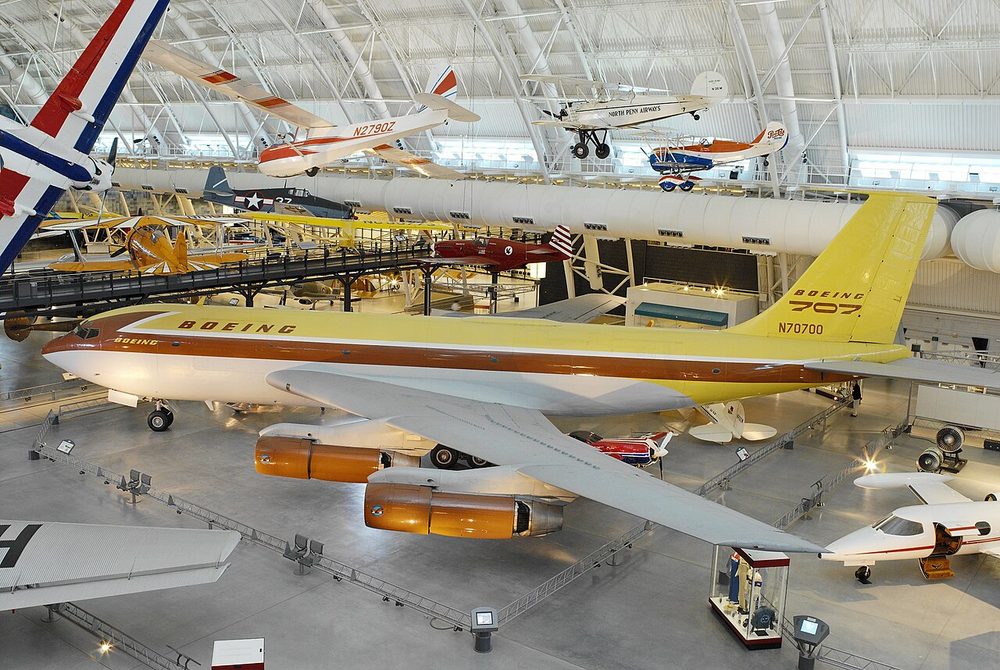
The real change came with the passenger aeroplane. In the 1930s, aircraft like the Douglas DC-3 made air travel reliable and comfortable enough for ordinary people, and after the Second World War, surplus military aircraft and new designs opened routes around the world. The de Havilland Comet, in 1952, was the first jet airliner; the Boeing 707, entering service in 1958, made jet travel routine. A journey from London to New York that had taken a week by ship now took eight hours. Concorde, flying from 1976, cut it to three and a half — but at a price few could afford, and it retired in 2003.
What flight changed
Flight shrank the world more than any invention before it. Families separated by oceans could visit each other. Fresh food could be flown from one continent to another. Business, tourism, and migration all became faster and cheaper. Aviation also changed warfare, medicine, and disaster relief — and it created new problems, including noise, pollution, and the climate impact of burning jet fuel, which the industry is now trying to solve with more efficient engines and new fuels.
It is worth remembering the scale of the change. The Wrights' first flight lasted 12 seconds; the first Moon landing came just 66 years later, in 1969. A person born in 1903 could have watched the first aeroplane and, in old age, watched astronauts walk on the Moon on television. No other technology in history has gone so far, so fast — from a sand dune in North Carolina to the surface of another world, in a single human lifetime.
| Milestone | Year | What happened |
|---|---|---|
| First powered flight | 1903 | Wright Flyer, 12 seconds, 120 feet |
| English Channel crossing | 1909 | Louis Blériot |
| First solo Atlantic crossing | 1927 | Charles Lindbergh, 33.5 hours |
| First jet airliner | 1952 | de Havilland Comet |
| Jet age begins | 1958 | Boeing 707 enters service |
Sources: NASA, "115 Years Ago: Wright Brothers Make History at Kitty Hawk"; US National Park Service, "Wright Brothers National Memorial"; Smithsonian National Air and Space Museum, "The Wright Brothers"; Britannica, "History of flight" Checked 27 November 2026.