Fire and Stone Tools: Humanity's First Technologies

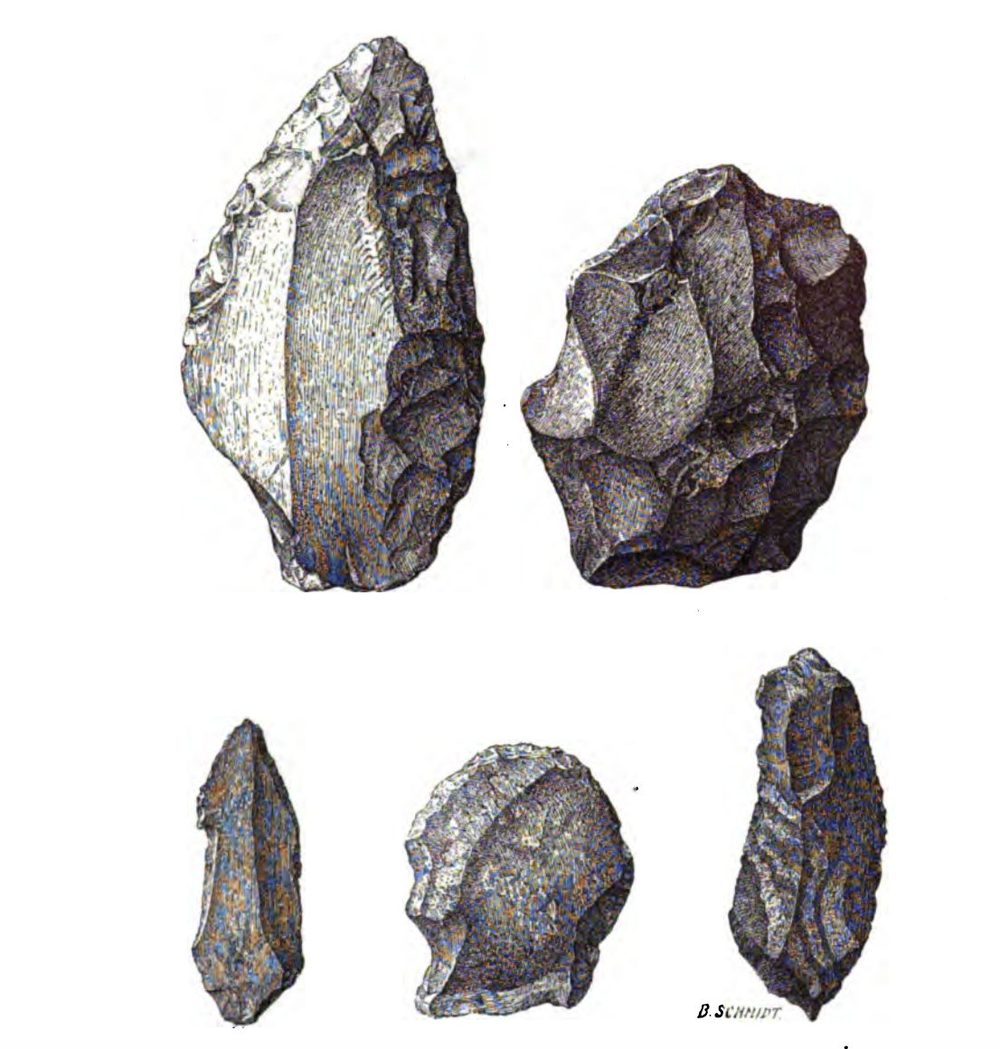

Long before there were cities, writing, or machines, there were two technologies that changed everything: a sharpened stone and a controlled flame. The oldest stone tools ever found are 3.3 million years old — older than our own species. Fire came later, but it may have mattered even more: it cooked our food, warmed our nights, kept predators away, and gave us somewhere to gather, talk, and plan. Every technology since is, in a sense, a refinement of these two ideas: shaping a material to do a job, and turning energy into something useful.
In short
The oldest known stone tools, found at Lomekwi in Kenya, are 3.3 million years old and predate the human genus itself. Controlled fire followed much later, around a million years ago, and it changed our diet, our bodies, and our social lives. Together, fire and stone tools are the foundation every later technology was built on.
The oldest tools in the world
In 2011, archaeologists working near Lake Turkana in Kenya took a wrong turn on the way to a dig site and ended up in a dried-up riverbed they had never surveyed. On the surface lay stones that had clearly been struck on purpose: sharp flakes, heavy cores, and flat stones used as anvils. When the sediments were dated, the result was startling — the tools at the site, called Lomekwi 3, are 3.3 million years old. They are the oldest stone tools ever discovered, about 700,000 years older than the previous record-holders from Gona in Ethiopia, which date to 2.6 million years ago.
What makes Lomekwi remarkable is not just its age but who made the tools. At 3.3 million years ago, no member of our genus, Homo, existed yet. The makers were probably Australopithecus or a close relative, Kenyanthropus — upright-walking ancestors with brains roughly a third the size of ours. The tools are large and crude compared with later ones, some weighing up to 15 kilograms, and they were made by holding a stone core on an anvil and striking it with a hammer stone to knock off sharp flakes. Those flakes could cut meat, scrape hides, and shape wood. The findings were published in the journal Nature in May 2015, and they pushed the origin of tool-making back by half a million years.
Later tool traditions were far more refined. The Oldowan tools of Gona, made from about 2.6 million years ago, were smaller and more standardised. Then, around 1.76 million years ago, came the hand axe — a teardrop-shaped stone worked carefully on both sides, the first tool with a planned, symmetrical shape. Hand axes stayed in use for more than a million years, longer than any technology before or since, and they spread from Africa across Europe and Asia with the humans who carried them.
Fire: the second great breakthrough
Stone tools let early humans cut and shape the world. Fire let them change it. The earliest strong evidence for controlled fire comes from Wonderwerk Cave in South Africa, where burned bones and plant ash in sediments about a million years old show that someone was deliberately keeping a fire going indoors. Other sites suggest fire use spread gradually over the following hundreds of thousands of years; it was not a single invention but a skill that had to be learned, kept alive, and passed on.
Fire did several things at once. It gave warmth in cold climates, which let humans move into Europe and northern Asia. It gave light after dark, extending the useful day. It kept predators away from sleeping groups. And, perhaps most importantly, it cooked food. Cooking softens tough meat and roots, kills germs and parasites, and releases far more energy from the same food. The anthropologist Richard Wrangham has argued that cooking was so important it reshaped our bodies: with food partly digested by fire, humans could evolve smaller guts and larger brains. That idea is still debated, but the link between cooked food and brain growth is now widely taken seriously.
Fire also changed how humans spent their evenings. A campfire is a natural gathering place, and researchers who study modern hunter-gatherers find that the conversations around a fire at night are different from daytime talk: longer stories, more planning, more talk about people who are not present. Fire may have been where storytelling — and with it, shared culture — began.
Why these two matter most
Fire and stone tools are not just old. They are the pattern for everything that followed. A stone tool is a material shaped for a purpose — the same idea as a steel blade, a silicon chip, or a spacecraft hull. Fire is energy captured and controlled — the same idea as a steam engine, a power station, or a nuclear reactor. Every later technology in this site's story combines those two moves: better materials, and better control of energy.
They also show something about how technology actually advances. It is slow, uneven, and often accidental — a wrong turn in Kenya, a fire kept alive through a winter. The hand axe was used for over a million years with almost no improvement. Then, in the last few thousand years, change accelerated beyond anything our ancestors could have imagined. The story of that acceleration starts with the next invention: the wheel.
| Milestone | When | Where |
|---|---|---|
| Oldest stone tools (Lomekwi 3) | 3.3 million years ago | Kenya |
| Oldowan tools (Gona) | 2.6 million years ago | Ethiopia |
| First hand axes | About 1.76 million years ago | Africa |
| Controlled fire (Wonderwerk Cave) | About 1 million years ago | South Africa |
Sources: Wikipedia, "Lomekwi"; Smithsonian Magazine, "The Oldest Stone Tools Yet Discovered Are Unearthed in Kenya"; Smithsonian National Museum of Natural History, Human Origins Program; Nature, Harmand et al., "3.3-million-year-old stone tools from Lomekwi 3, West Turkana, Kenya" (2015) Checked 27 November 2026.